

An investor's job is difficult amidst chaos

Peek of the Week
Weekly Market Commentary
September 28, 2026
The Markets
Keep your eye on your long-term goals.
Batters have one of the most difficult jobs in baseball: keeping their eyes on the ball. It seems straightforward, but there are always distractions, from a pitcher’s pacing to the fans’ heckling. As Crash Davis points out in Bull Durham, “Know what the difference between hitting .250 and .300 is? It's 25 hits - 25 hits in 500 at-bats is 50 points.”
An investor's job is difficult, too, especially during election season. For investors, the challenge is to stay calm and focus on their long-term goals. It isn’t easy amid the chaos of political noise when emotions are running high. It can help to remember that stocks have trended higher historically regardless of which party is in power or how the government is configured.
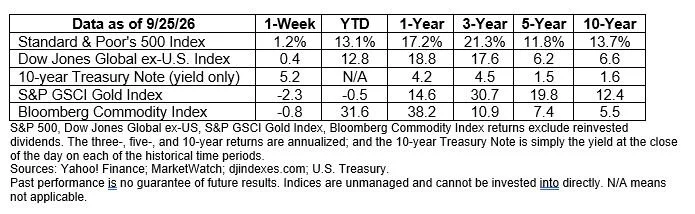
While you cannot invest directly in an index, the Standard & Poor’s 500 Index illustrates the point well. In January 1945, the Index was trading at 13.50. Last Friday, it finished at 7,743.40. There were a lot of ups and downs in between those years, but stocks trended higher overall.
Historical stock market performance doesn’t mean politics is irrelevant
The United States government sets policies and appoints officials that affect Americans’ lives every day. For the 2026 midterms, economic issues are top of mind for many voters, according to Pew Research. The economic issues Americans are thinking about include:
The cost of living. Most participants in a Pew Research survey said they were very concerned about the cost of healthcare, food, consumer goods, housing, gasoline, and electricity. They also were focused on the role of artificial intelligence in the economy and the difficulty many people are having finding work.
“By a wide margin, voters most want candidates running for Congress to talk about economic issues – with many specifically mentioning prices and affordability,” reported Andrew Daniller, Andy Cerda, Hannah Hartig and J. Baxter Oliphant of Pew.
Social Security funding. “A near-unanimous 97 percent of voters nationwide agree candidates should explain their plans to prevent automatic benefit cuts…this is an intergenerational issue: while current retirees will be impacted immediately by automatic cuts, current workers are paying into a system that will pay them less,” according to a survey conducted by the nonpartisan Peter G. Peterson Foundation.
Currently, payroll taxes collected to fund Social Security benefits do not cover the amount paid out each year. The difference is taken from the Old-Age, Survivors Insurance (OASI) Trust Fund. Projections suggest the trust fund will be depleted in 2032. Unless Congress acts soon, all program beneficiaries will see benefits cut by 22 percent, according to the 2026 Annual Trustees Report. The Committee for a Responsible Federal Budget puts the cut at about $16,900 per year for the average couple.
Americans also are concerned about non-economic issues, including government and leadership, immigration, and war in the Middle East, according to a September Gallup poll.
Just as hitters can be enticed into swinging at the wrong pitches, investors can be tempted to make portfolio changes at the wrong times. During this election season, remember to keep your eye on your long-term goals. If you have questions about your portfolio or feel a change may be warranted, please get in touch.
Last week, “was a rollercoaster of a week on Wall Street, but stocks closed Friday's session higher and managed to climb for the week despite the bond yields rising to multi-year highs,” reported Naomi Buchanan of Barron’s. The yield on the 30-year U.S. Treasury bond ended the week at 5.49 percent
WHAT DO SALT, CATTLE, COINS, AND A SMARTPHONE HAVE IN COMMON? At one time, each played a part in a payment system. In the ancient world, salt and cattle were forms of currency. Today, the wallet app on your phone can pay for your morning coffee. Find out what you know about the history of money by taking this brief quiz.
1. In the late 1800s, some stores allowed well-heeled customers to charge purchases using a store token. The tokens included the store's name or logo, a customer identification number, and a small hole so the customer could string it on a key ring or necklace. The tokens were often shaped like the goods sold by the issuing store. What were these tokens called?
Razzle dazzle
Charge coins
Credit chits
Plunk downs
2. In the 1930s, one industry embraced the idea of charge cards. The card offered customers a more convenient way to pay and provided a 15 percent discount on some sales. What did the industry call its card?
The Rail Travel Card
The Motion Picture Show Card
The Air Travel Card
The Coffee-House Card
3. The first multi-purpose credit card was introduced in 1950. It could be used at 28 restaurants and two hotels, and the balance had to be paid off every month. What material was the card made of?
Aluminum
Plastic
Cardboard
Celluloid
4. Today, contactless payment lets people pay with a debit or credit card by tapping the card, smartphone, or smartwatch on a payment terminal. Where was the technology first used?
The United States
South Korea
China
Canada
From salt and cattle to cardboard cards and contactless payments, the way we pay has changed dramatically over time. Who knows what will be in our wallets, or on our phones, a generation from now?
WEEKLY FOCUS – THINK ABOUT IT
“Money is, in some respects, like fire. It is a very excellent servant, but a terrible master.”
— P.T. Barnum, Entertainment Entrepreneur
Answers: 1) 2; 2) 3; 3) 3; 4) 2
Best regards,
Leif M. Hagen, CLU, ChFC
LPL Financial Advisor
Achievement Financial
Dream. Plan. Achieve.
P.S. Please feel free to forward this commentary to family, friends, or colleagues. If you would like us to add them to the list, please reply to this email with their email address and we will ask for their permission to be added.
Securities offered through LPL Financial, Member FINRA/SIPC.

* These views are those of Carson Coaching, not the presenting Representative, the Representative’s Broker/Dealer, or Registered Investment Advisor, and should not be construed as investment advice.
* This newsletter was prepared by Carson Coaching. Carson Coaching is not affiliated with the named firm or broker/dealer.
* Government bonds and Treasury Bills are guaranteed by the U.S. government as to the timely payment of principal and interest and, if held to maturity, offer a fixed rate of return and fixed principal value. However, the value of fund shares is not guaranteed and will fluctuate.
* Corporate bonds are considered higher risk than government bonds but normally offer a higher yield and are subject to market, interest rate and credit risk as well as additional risks based on the quality of issuer coupon rate, price, yield, maturity, and redemption features.
* The Standard & Poor's 500 (S&P 500) is an unmanaged group of securities considered to be representative of the stock market in general. You cannot invest directly in this index.
* All indexes referenced are unmanaged. The volatility of indexes could be materially different from that of a client’s portfolio. Unmanaged index returns do not reflect fees, expenses, or sales charges. Index performance is not indicative of the performance of any investment. You cannot invest directly in an index.
* The Dow Jones Global ex-U.S. Index covers approximately 95% of the market capitalization of the 45 developed and emerging countries included in the Index.
* The 10-year Treasury Note represents debt owed by the United States Treasury to the public. Since the U.S. Government is seen as a risk-free borrower, investors use the 10-year Treasury Note as a benchmark for the long-term bond market.
* Gold represents the 3:00 p.m. (London time) gold price as reported by the London Bullion Market Association and is expressed in U.S. Dollars per fine troy ounce. The source for gold data is Federal Reserve Bank of St. Louis (FRED), https://fred.stlouisfed.org/series/GOLDPMGBD228NLBM.
* The Bloomberg Commodity Index is designed to be a highly liquid and diversified benchmark for the commodity futures market. The Index is composed of futures contracts on 19 physical commodities and was launched on July 14, 1998.
* The DJ Equity All REIT Total Return Index measures the total return performance of the equity subcategory of the Real Estate Investment Trust (REIT) industry as calculated by Dow Jones.
* The Dow Jones Industrial Average (DJIA), commonly known as “The Dow,” is an index representing 30 stock of companies maintained and reviewed by the editors of The Wall Street Journal.
* The NASDAQ Composite is an unmanaged index of securities traded on the NASDAQ system.
* International investing involves special risks such as currency fluctuation and political instability and may not be suitable for all investors. These risks are often heightened for investments in emerging markets.
* Yahoo! Finance is the source for any reference to the performance of an index between two specific periods.
* The risk of loss in trading commodities and futures can be substantial. You should therefore carefully consider whether such trading is suitable for you in light of your financial condition. The high degree of leverage is often obtainable in commodity trading and can work against you as well as for you. The use of leverage can lead to large losses as well as gains.
* Opinions expressed are subject to change without notice and are not intended as investment advice or to predict future performance.
* Economic forecasts set forth may not develop as predicted and there can be no guarantee that strategies promoted will be successful.
* Past performance does not guarantee future results. Investing involves risk, including loss of principal.
* The foregoing information has been obtained from sources considered to be reliable, but we do not guarantee it is accurate or complete.
* There is no guarantee a diversified portfolio will enhance overall returns or outperform a non-diversified portfolio. Diversification does not protect against market risk.
* Asset allocation does not ensure a profit or protect against a loss.
* Consult your financial professional before making any investment decision.
* To unsubscribe from the “Peek of the Week” please reply to this email with “Unsubscribe” in the subject line or write us at Leif@AchievementFinancial.com
Sources:
https://www.azquotes.com/quote/1122379
https://www.multpl.com/s-p-500-historical-prices/table/by-year
https://finance.yahoo.com/quote/%5EGSPC/history/
https://www.ssa.gov/oact/tr/2026/tr2026.pdf
https://www.crfb.org/blogs/large-benefit-cuts-loom-social-security
https://news.gallup.com/poll/1675/most-important-problem.aspx
https://www.barrons.com/livecoverage/stock-market-news-today-092526 or go to https://resources.carsongroup.com/hubfs/WMC-Source/2026/09-28-26-Barrons-Stocks-End-Volatile-Week%20-%2010.pdf
https://www.experian.com/blogs/ask-experian/the-history-of-credit-cards/
https://www.creditcollectibles.com/evolution-of-charge-coins-to-credit-cards/
https://apex.aero/articles/credit-history-birth-air-travel-card/
https://www.dinersclubus.com/home/about/dinersclub/story
https://www.globalpaymentsintegrated.com/en-us/blog/2020/09/15/the-history-of-contactless-payments