

How many jobs could disappear if AI is here to stay?

Peek of the Week
Weekly Market Commentary
March 2, 2026
The Markets
Artificial Intelligence (AI) is the new Industrial Revolution.
Last week, market volatility reflected uncertainty about how artificial intelligence will reshape the economy. Early in the week, a report titled “The 2028 Global Intelligence Crisis” alarmed investors by describing a hypothetical future where artificial intelligence tools greatly improve productivity, causing white-collar jobs to vanish, and unemployment to rise above 10 percent.
Innovation and disruption is not new
It’s likely that some types of employment will disappear as AI advances. However, AI is also expected to create new types of employment, just as previous disruptive innovation has done. Kenneth G. Pringle of Barron’s explained:
“That AI technology will come for jobs is certain. The destruction and creation of jobs is a defining characteristic of the Industrial Revolution. Less certain is what kind of new jobs—and how many—will take their place…Think of the automobile industry replacing the horse-and-carriage trade in the first decades of the 20th century, or IT departments supplanting secretarial pools in recent decades…The new jobs can be vastly different in nature, requiring novel skills and perhaps relocation, such as from farm to city in the first Industrial Revolution.”
The current state of AI
Markets calmed during the week as investors recognized that the pace of AI adoption has been slow. In late 2025, about 37 percent of Americans used generative AI (GenAI) at work, according to Alexander Bick, Adam Blandin, and David Deming of the St. Louis Federal Reserve bank.
GenAI was introduced just three years ago, so it’s likely to be more widely adopted over time. Adoption may be slow with AI tools gaining users and increasing productivity over an extended period, mirroring the adoption of computers and software. That said, AI agents, which arrived last year, have the potential to accelerate change. However, according to Edward Harrison of Bloomberg:
“Gartner expects over 40 [percent] of agentic AI projects to be canceled by 2027. Not only are companies unlikely to make immediate and wrenching company-wide changes, they won’t even be able to extract enough benefits from the projects they have in place any time soon. Just as with the personal computer and Internet revolutions before AI, it will be years before households and companies work out how to get benefits from the new technology.”
Friday’s employment scare
The calm didn’t last long. On Friday, markets jolted again when a major financial technology company cut 40 percent of its workforce. The company’s founder wrote, “intelligence tools we’re creating and using, paired with smaller and flatter teams, are enabling a new way of working which fundamentally changes what it means to build and run a company,” reported Connor Smith of Barron’s.
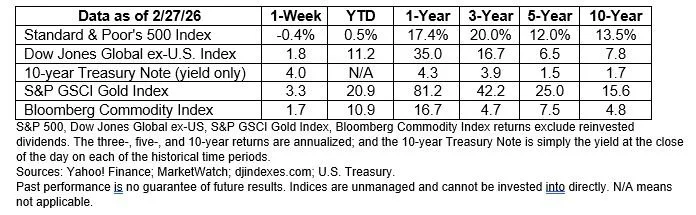
Major U.S. stock indexes finished the w
WHAT DO YOU KNOW ABOUT AI? Kevin Warsh, who has been nominated to lead the Federal Reserve (Fed), faces a significant challenge. Along with the other members of the Federal Open Market Committee, he will be responsible for monetary policy and economic stability during a period of enormous innovation. AI tools are likely to change business models and workflows, just as the introduction of the printing press, electricity, the telephone, and the automobile did. See what you know about AI by taking this brief quiz.
1. GenAI is best known for helping people:
Write difficult math equations
Generate new content like text, images, or video
Reach conclusions without any data
Wash cars and bikes
2. Which of these products relies on AI?
Navigation apps
Self-driving cars
Virtual assistants
All of the above
3. In late 2024, Gallup asked Americans whether they had used AI-enabled products during the previous week. Thirty-six percent said yes, 50 percent said no, and 14 percent weren’t sure. When survey participants were questioned further, it turned out many were using at least one AI-enabled product without realizing it. What percentage had used AI-enabled products during the previous week?
36 percent
64 percent
83 percent
99 percent
4. The first AI chatbot was named Eliza. The bot was developed at MIT. When it was given a “Doctor” prompt, it would interact with the user as though it was a therapist and the user was a patient. When was this bot built?
1941 to 1944
1964 to 1967
2002 to 2005
2016 to 2020
WEEKLY FOCUS – THINK ABOUT IT
“We are going to have to have different ethics for different artificially intelligent machines. You obviously want a different set of ethics for a military artificially intelligent machine or robot than you have for a care-taking robot.”
― Gray Scott, Futurist
Answers: 1) 2; 2) 4; 3) 4; 4) 2
Best regards,
Leif M. Hagen, CLU, ChFC
LPL Financial Advisor
Achievement Financial
Dream. Plan. Achieve.
P.S. Please feel free to forward this commentary to family, friends, or colleagues. If you would like us to add them to the list, please reply to this email with their email address and we will ask for their permission to be added.
Securities offered through LPL Financial Member FINRA/SIPC.

* These views are those of Carson Coaching, not the presenting Representative, the Representative’s Broker/Dealer, or Registered Investment Advisor, and should not be construed as investment advice.
* This newsletter was prepared by Carson Coaching. Carson Coaching is not affiliated with the named firm or broker/dealer.
* Government bonds and Treasury Bills are guaranteed by the U.S. government as to the timely payment of principal and interest and, if held to maturity, offer a fixed rate of return and fixed principal value. However, the value of fund shares is not guaranteed and will fluctuate.
* Corporate bonds are considered higher risk than government bonds but normally offer a higher yield and are subject to market, interest rate and credit risk as well as additional risks based on the quality of issuer coupon rate, price, yield, maturity, and redemption features.
* The Standard & Poor's 500 (S&P 500) is an unmanaged group of securities considered to be representative of the stock market in general. You cannot invest directly in this index.
* All indexes referenced are unmanaged. The volatility of indexes could be materially different from that of a client’s portfolio. Unmanaged index returns do not reflect fees, expenses, or sales charges. Index performance is not indicative of the performance of any investment. You cannot invest directly in an index.
* The Dow Jones Global ex-U.S. Index covers approximately 95% of the market capitalization of the 45 developed and emerging countries included in the Index.
* The 10-year Treasury Note represents debt owed by the United States Treasury to the public. Since the U.S. Government is seen as a risk-free borrower, investors use the 10-year Treasury Note as a benchmark for the long-term bond market.
* Gold represents the 3:00 p.m. (London time) gold price as reported by the London Bullion Market Association and is expressed in U.S. Dollars per fine troy ounce. The source for gold data is Federal Reserve Bank of St. Louis (FRED), https://fred.stlouisfed.org/series/GOLDPMGBD228NLBM.
* The Bloomberg Commodity Index is designed to be a highly liquid and diversified benchmark for the commodity futures market. The Index is composed of futures contracts on 19 physical commodities and was launched on July 14, 1998.
* The DJ Equity All REIT Total Return Index measures the total return performance of the equity subcategory of the Real Estate Investment Trust (REIT) industry as calculated by Dow Jones.
* The Dow Jones Industrial Average (DJIA), commonly known as “The Dow,” is an index representing 30 stock of companies maintained and reviewed by the editors of The Wall Street Journal.
* The NASDAQ Composite is an unmanaged index of securities traded on the NASDAQ system.
* International investing involves special risks such as currency fluctuation and political instability and may not be suitable for all investors. These risks are often heightened for investments in emerging markets.
* Yahoo! Finance is the source for any reference to the performance of an index between two specific periods.
* The risk of loss in trading commodities and futures can be substantial. You should therefore carefully consider whether such trading is suitable for you in light of your financial condition. The high degree of leverage is often obtainable in commodity trading and can work against you as well as for you. The use of leverage can lead to large losses as well as gains.
* Opinions expressed are subject to change without notice and are not intended as investment advice or to predict future performance.
* Economic forecasts set forth may not develop as predicted and there can be no guarantee that strategies promoted will be successful.
* Past performance does not guarantee future results. Investing involves risk, including loss of principal.
* The foregoing information has been obtained from sources considered to be reliable, but we do not guarantee it is accurate or complete.
* There is no guarantee a diversified portfolio will enhance overall returns or outperform a non-diversified portfolio. Diversification does not protect against market risk.
* Asset allocation does not ensure a profit or protect against a loss.
* Consult your financial professional before making any investment decision.
* To unsubscribe from the “Peek of the Week” please reply to this email with “Unsubscribe” in the subject line or write us at Leif@AchievementFinancial.com
Sources:
https://substack.com/home/post/p-188821754
https://www.barrons.com/articles/ai-history-lessons-jobs-destroyed-created-cdcd0d71 or go to https://resources.carsongroup.com/hubfs/WMC-Source/2026/03-02-26-Barrons-AI-Will-Create-And-Destroy-Jobs%20-%202.pdf
https://www.stlouisfed.org/on-the-economy/2025/nov/state-generative-ai-adoption-2025
https://www.computerhistory.org/timeline/computers/
https://www.bloomberg.com/news/newsletters/2026-02-25/ai-s-disruption-will-prove-beneficial-to-consumers-and-businesses or go to https://resources.carsongroup.com/hubfs/WMC-Source/2026/03-02-26-Bloomberg-AIs-Beneficial-Disruption%20-%205.pdf
https://www.barrons.com/livecoverage/stock-market-news-today-022726?mod=hp_LEDE_C_1 or go to https://resources.carsongroup.com/hubfs/WMC-Source/2026/03-02-26-Barrons-Dow-Drops-520-Points%20-%206.pdf
https://www.barrons.com/market-data?mod=BOL_TOPNAV or go to https://resources.carsongroup.com/hubfs/WMC-Source/2026/03-02-26-Barrons-DJIA-S&P-Nasdaq%20-%207.pdf
https://en.wikipedia.org/wiki/Generative_artificial_intelligence?
https://news.gallup.com/poll/654905/americans-everyday-products-without-realizing.aspx