

The global economy gets tested by global conflict

Peek of the Week
Weekly Market Commentary
March 30, 2026
The Markets
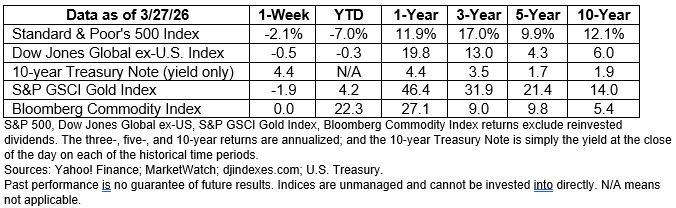
U.S. stocks moved lower last week.
The journey toward long-term financial goals is often interrupted by unexpected events that create stress and uncertainty. That’s one reason financial plans are built with a keen eye to risk tolerance. When disruptive events occur and financial markets lose value, even the most experienced investors have questions and concerns.
Over the last few months, markets have traveled a particularly bumpy road. We’ve seen:
Geopolitics create uncertainty. The United States government has been reshaping economic and geopolitical relationships with the rest of the world. Last week, the military conflict in Iran took a toll on financial markets. Lu Wang and Isabelle Lee of Bloomberg reported, “Market declines sparked by the Iran war are morphing into a full-blown rout across Wall Street. Efforts to broker an end to the fighting and restart the flow of Middle East oil produced only further escalation, which in turn fueled an ever-greater sense of dread in markets.”
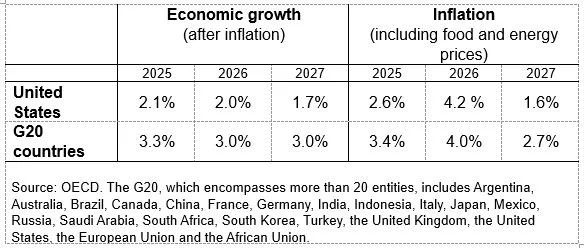
Forecasts for economic growth and inflation change. Last week, the Organization for Economic Cooperation and Development (OECD) stated that “conflict in the Middle East is testing the resilience of the global economy.” Its March 2026 Economic Outlook forecasts that inflation will move sharply higher in 2026.
Consumer optimism fade. In early March, consumer sentiment improved. Those gains reversed later in the month after the conflict in Iran began, according to the University of Michigan (UofM) Consumer Survey. By month’s end, the Sentiment Index was lower month over month and year over year.
“Consumers with middle and higher incomes and stock wealth, buffeted by both escalating gas prices and volatile financial markets in the wake of the Iran conflict, exhibited particularly large drops in sentiment,” reported Surveys of Consumers Director Joanne Hsu.
Sentiment is an important indicator of consumer spending, which is the key driver of U.S. economic growth. Falling sentiment may translate to lower spending and slower economic growth, and vice versa, reported Aja McClanahan of U.S. News & World Report.
Government deficits and debts increase. Last week, the U.S. national debt rose above $39 trillion for the first time, according to the Peter G. Peterson Foundation, causing the U.S. Fiscal Confidence Index to drop to the lowest level in nearly two years. “There is a fundamental imbalance between [government] spending and [tax] revenues that will continue to grow in future years,” reported the Foundation.
Last week, the Nasdaq Composite Index and Dow Jones Industrial Average both moved into correction territory, meaning they declined 10 percent or more from previous highs. The Standard & Poor’s 500 Index also moved lower, according to Jacob Sonenshine of Barron’s. Bond yields rose, influenced “by rising inflation expectations but also by a repricing of what central banks intend to do next, a shift playing out from Washington to Frankfurt to Tokyo, according to Wang and Lee.
If you’re feeling uncertain, please get in touch. We’re happy to discuss any questions or concerns you may have.
WHAT DO YOU KNOW ABOUT FICTIONAL WEALTH? When markets are volatile, we can all use some light-hearted fun. Recently, a financial website picked up where Forbes left off in 2013 by publishing the “Fictional 15”, a list of wealthy characters from fiction (movies, books, cartoons, television, video games, and comics). See what you know about fictional wealth by taking this brief quiz.
Why did Forbes originally create the Fictional 15 List?
Estimating the wealth of dragons, comic book moguls, and cartoon tycoons, allowed Forbes analysts to explore unconventional asset classes.
Cruella de Vil financed it because she likes to see her name in print.
Wealthy people often are reduced to caricatures, Forbes decided to satirize that by treating fictional characters as real people.
People like reading about wealthy people, fictional or not.
2. Which fictional character topped the 2025 list of richest fictional characters?
Scrooge McDuck, richest duck in the world
Forrest Gump, shrimping magnate
T’Challa, King of Wakanda
Tony Stark, Iron Man
3. Why was Santa Claus removed from the Forbes Fictional 15 list?
Santa preferred not to publish data about his net worth.
Analysts struggled to apply traditional valuation models to Santa’s operation.
People objected to Santa being on a list of fictional characters.
Santa’s business model of delivering packages for free in a single night was economically disruptive.
4. Who was the only woman to be included on the list in 2025?
Carol Miller, Mom in Futurama
Lara Croft, Archeologist
Lady Mary Crawley, Downton Abbey
The Tooth Fairy
While none of us has a dragon’s hoard or a magic money tree, we all have the opportunity to build wealth by saving and investing.
WEEKLY FOCUS – THINK ABOUT IT
“Passion is one great force that unleashes creativity, because if you're passionate about something, then you're more willing to take risks.”
― Yo-Yo Ma, Cellist
Answers: 1) 3; 2) 3; 3) 3; 4) 2
Best regards,
Leif M. Hagen, CLU, ChFC
LPL Financial Advisor
Achievement Financial
Dream. Plan. Achieve.
P.S. Please feel free to forward this commentary to family, friends, or colleagues. If you would like us to add them to the list, please reply to this email with their email address and we will ask for their permission to be added.
Securities offered through LPL Financial, Member FINRA/SIPC.

* These views are those of Carson Coaching, not the presenting Representative, the Representative’s Broker/Dealer, or Registered Investment Advisor, and should not be construed as investment advice.
* This newsletter was prepared by Carson Coaching. Carson Coaching is not affiliated with the named firm or broker/dealer.
* Government bonds and Treasury Bills are guaranteed by the U.S. government as to the timely payment of principal and interest and, if held to maturity, offer a fixed rate of return and fixed principal value. However, the value of fund shares is not guaranteed and will fluctuate.
* Corporate bonds are considered higher risk than government bonds but normally offer a higher yield and are subject to market, interest rate and credit risk as well as additional risks based on the quality of issuer coupon rate, price, yield, maturity, and redemption features.
* The Standard & Poor's 500 (S&P 500) is an unmanaged group of securities considered to be representative of the stock market in general. You cannot invest directly in this index.
* All indexes referenced are unmanaged. The volatility of indexes could be materially different from that of a client’s portfolio. Unmanaged index returns do not reflect fees, expenses, or sales charges. Index performance is not indicative of the performance of any investment. You cannot invest directly in an index.
* The Dow Jones Global ex-U.S. Index covers approximately 95% of the market capitalization of the 45 developed and emerging countries included in the Index.
* The 10-year Treasury Note represents debt owed by the United States Treasury to the public. Since the U.S. Government is seen as a risk-free borrower, investors use the 10-year Treasury Note as a benchmark for the long-term bond market.
* Gold represents the 3:00 p.m. (London time) gold price as reported by the London Bullion Market Association and is expressed in U.S. Dollars per fine troy ounce. The source for gold data is Federal Reserve Bank of St. Louis (FRED), https://fred.stlouisfed.org/series/GOLDPMGBD228NLBM.
* The Bloomberg Commodity Index is designed to be a highly liquid and diversified benchmark for the commodity futures market. The Index is composed of futures contracts on 19 physical commodities and was launched on July 14, 1998.
* The DJ Equity All REIT Total Return Index measures the total return performance of the equity subcategory of the Real Estate Investment Trust (REIT) industry as calculated by Dow Jones.
* The Dow Jones Industrial Average (DJIA), commonly known as “The Dow,” is an index representing 30 stock of companies maintained and reviewed by the editors of The Wall Street Journal.
* The NASDAQ Composite is an unmanaged index of securities traded on the NASDAQ system.
* International investing involves special risks such as currency fluctuation and political instability and may not be suitable for all investors. These risks are often heightened for investments in emerging markets.
* Yahoo! Finance is the source for any reference to the performance of an index between two specific periods.
* The risk of loss in trading commodities and futures can be substantial. You should therefore carefully consider whether such trading is suitable for you in light of your financial condition. The high degree of leverage is often obtainable in commodity trading and can work against you as well as for you. The use of leverage can lead to large losses as well as gains.
* Opinions expressed are subject to change without notice and are not intended as investment advice or to predict future performance.
* Economic forecasts set forth may not develop as predicted and there can be no guarantee that strategies promoted will be successful.
* Past performance does not guarantee future results. Investing involves risk, including loss of principal.
* The foregoing information has been obtained from sources considered to be reliable, but we do not guarantee it is accurate or complete.
* There is no guarantee a diversified portfolio will enhance overall returns or outperform a non-diversified portfolio. Diversification does not protect against market risk.
* Asset allocation does not ensure a profit or protect against a loss.
* Consult your financial professional before making any investment decision.
* To unsubscribe from the “Peek of the Week” please reply to this email with “Unsubscribe” in the subject line or write us at Leif@AchievementFinancial.com
Sources:
https://www.bloomberg.com/news/articles/2026-03-27/wall-street-reels-as-iran-war-shatters-its-portfolio-defenses?srnd=homepage-americas or go to https://resources.carsongroup.com/hubfs/WMC-Source/2026/03-30-26-Bloomberg-Wall-Street-Reels%20-%201.pdf
https://www.sca.isr.umich.edu or go to https://resources.carsongroup.com/hubfs/WMC-Source/2026/03-30-26-U-of-M-Surveys-of-Consumers%20-%203.pdf
https://www.pgpf.org/press/2026-3-fci-press-release/
https://www.pgpf.org/our-national-debt/
https://www.barrons.com/articles/stock-market-bottom-closer-than-you-think-a61e7557? or go to https://resources.carsongroup.com/hubfs/WMC-Source/2026/03-30-26-Barrons-The-Stock-Markets-Bottom%20-%207.pdf
https://en.wikipedia.org/wiki/Forbes_Fictional_15
html https://www.yahoo.com/lifestyle/articles/15-richest-fictional-characters-much-000009560.html
https://www.forbes.com/2005/12/01/fictional15-rich-methodology-cx_mn_1201method.