

The markets like predictability

Peek of the Week
Weekly Market Commentary
October 19, 2026
The Markets
One thing leads to another.
In 2009, a team of domino builders in the Netherlands attempted to topple 4.8 million dominoes. Just 4.4 million fell, but that was enough to set a Guinness World Record that stands today. With dominoes, a gentle push starts a chain reaction. Rising prices can move through the economy in a similar way. In March of this year, fuel and energy prices began to rise. Businesses in the United States felt the change first.
The first dominoes are producer prices
The Producer Price Index (PPI) measures what businesses receive for the goods and services they sell. In September, prices were up 6.3 percent over the last 12 months. Some businesses have absorbed at least part of the cost increases they’ve experienced so far, while others have passed them along to customers, according to the Federal Reserve Beige Book for October. The Beige Book describes current economic conditions across the 12 Federal Reserve Districts.
Producer prices affect consumer prices
The Consumer Price Index (CPI) keeps track of what consumers pay for everyday goods and services. Consumer prices were 3.7 percent year over year in September, a faster increase than 3.4 percent in August. One reason prices rose so quickly was the cost of fuel. Gasoline prices were up 34.2 percent year over year. Core inflation, which excludes volatile food and energy prices, rose 2.6 percent since the same month last year, up from 2.4 percent in August.
Consumer prices can affect wages
As prices move higher, wages often move higher, too. The Beige Book found “that inflation has spawned additional wage pressure in the form of higher cost-of-living demands from individuals as well as challenges from rising benefit costs.” The most recent employment report showed that average hourly earnings rose 3.0 percent year over year in September, not quite matching price increases.
The Federal Reserve (Fed) raises rates to tame inflation and that can affect markets
The Fed raised the federal funds rate in September in an effort to slow price increases. Fed rate hikes often push interest rates higher, which can make borrowing more expensive, affecting both company profitability and stock prices.
Last week, markets were quite volatile, in part because of concerns the Fed may raise rates again to tame inflation. Higher rates could have an outsized effect on AI-related companies that have borrowed to finance projects, reported Reuters.
“The week ended with a dramatic rethink of the engine driving the bull market: the AI trade,” reported Naomi Buchanan of Barron’s. “Despite the tech downturn, most sectors actually ended the week in the green, signaling there’s a rotation out of tech into other areas of the equity market.”
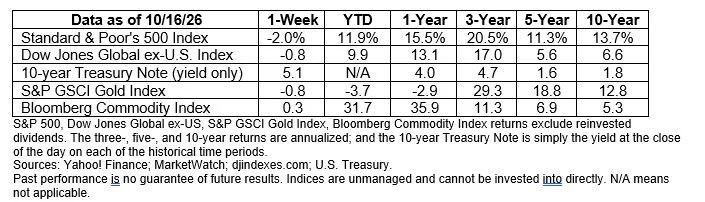
The Dow Jones Industrial Average finished the week higher because it is less sensitive to AI concerns than the Standard & Poor’s 500 Index and Nasdaq Composite, which both finished the week lower. Yields on longer maturities of U.S. Treasuries moved lower over the week.
MARKETS LIKE PREDICTABILITY. The midterm elections are almost here. Soon, voters will head to the polls to decide which party will be in control of Congress. The decision determines how easy it will be for the sitting administration to accomplish its party’s legislative agenda. Typically, the outcome reflects how happy or unhappy voters are with the president, reported James FitzGerald of BBC News.
Historically, the president’s party tends to lose seats in midterm elections, which makes a divided government more likely. The good news is that financial markets seem to like it when the parties split power. Dan Burrows of Kiplinger explained:
“A divided Congress is often positive for the stock market. After all, the status quo can be preferable to the uncertainty of sweeping legislative changes…Who holds power in Washington, D.C., matters, of course, but not nearly as much as the outlook for corporate earnings, interest rates and the macroeconomic environment…”
Be cautious about making changes to your portfolio for political reasons
When dramatic campaign ads fill the airwaves with dire warnings about what will happen if one party or the other wins, many people worry about how the election might affect their savings and investments.
“Midterm elections have a well-earned reputation for making investors a little nervous, as the stock market has often experienced greater volatility and weaker returns during midterm years. Many investors, though, may be surprised to learn that stocks have almost always generated stronger returns in the following year,” reported Fidelity Viewpoints.
If political rhetoric has you wondering whether you should make changes to your portfolio, please get in touch. We can discuss your concerns and decide on a course of action.
WEEKLY FOCUS – THINK ABOUT IT
“Every election is determined by the people who show up.”
— Larry Sabato, Political Scientist
Best regards,
Leif M. Hagen, CLU, ChFC
LPL Financial Advisor
Achievement Financial
Dream. Plan. Achieve.
P.S. Please feel free to forward this commentary to family, friends, or colleagues. If you would like us to add them to the list, please reply to this email with their email address and we will ask for their permission to be added.
Securities offered through LPL Financial, Member FINRA/SIPC.

* These views are those of Carson Coaching, not the presenting Representative, the Representative’s Broker/Dealer, or Registered Investment Advisor, and should not be construed as investment advice.
* This newsletter was prepared by Carson Coaching. Carson Coaching is not affiliated with the named firm or broker/dealer.
* Government bonds and Treasury Bills are guaranteed by the U.S. government as to the timely payment of principal and interest and, if held to maturity, offer a fixed rate of return and fixed principal value. However, the value of fund shares is not guaranteed and will fluctuate.
* Corporate bonds are considered higher risk than government bonds but normally offer a higher yield and are subject to market, interest rate and credit risk as well as additional risks based on the quality of issuer coupon rate, price, yield, maturity, and redemption features.
* The Standard & Poor's 500 (S&P 500) is an unmanaged group of securities considered to be representative of the stock market in general. You cannot invest directly in this index.
* All indexes referenced are unmanaged. The volatility of indexes could be materially different from that of a client’s portfolio. Unmanaged index returns do not reflect fees, expenses, or sales charges. Index performance is not indicative of the performance of any investment. You cannot invest directly in an index.
* The Dow Jones Global ex-U.S. Index covers approximately 95% of the market capitalization of the 45 developed and emerging countries included in the Index.
* The 10-year Treasury Note represents debt owed by the United States Treasury to the public. Since the U.S. Government is seen as a risk-free borrower, investors use the 10-year Treasury Note as a benchmark for the long-term bond market.
* Gold represents the 3:00 p.m. (London time) gold price as reported by the London Bullion Market Association and is expressed in U.S. Dollars per fine troy ounce. The source for gold data is Federal Reserve Bank of St. Louis (FRED), https://fred.stlouisfed.org/series/GOLDPMGBD228NLBM.
* The Bloomberg Commodity Index is designed to be a highly liquid and diversified benchmark for the commodity futures market. The Index is composed of futures contracts on 19 physical commodities and was launched on July 14, 1998.
* The DJ Equity All REIT Total Return Index measures the total return performance of the equity subcategory of the Real Estate Investment Trust (REIT) industry as calculated by Dow Jones.
* The Dow Jones Industrial Average (DJIA), commonly known as “The Dow,” is an index representing 30 stock of companies maintained and reviewed by the editors of The Wall Street Journal.
* The NASDAQ Composite is an unmanaged index of securities traded on the NASDAQ system.
* International investing involves special risks such as currency fluctuation and political instability and may not be suitable for all investors. These risks are often heightened for investments in emerging markets.
* Yahoo! Finance is the source for any reference to the performance of an index between two specific periods.
* The risk of loss in trading commodities and futures can be substantial. You should therefore carefully consider whether such trading is suitable for you in light of your financial condition. The high degree of leverage is often obtainable in commodity trading and can work against you as well as for you. The use of leverage can lead to large losses as well as gains.
* Opinions expressed are subject to change without notice and are not intended as investment advice or to predict future performance.
* Economic forecasts set forth may not develop as predicted and there can be no guarantee that strategies promoted will be successful.
* Past performance does not guarantee future results. Investing involves risk, including loss of principal.
* The foregoing information has been obtained from sources considered to be reliable, but we do not guarantee it is accurate or complete.
* There is no guarantee a diversified portfolio will enhance overall returns or outperform a non-diversified portfolio. Diversification does not protect against market risk.
* Asset allocation does not ensure a profit or protect against a loss.
* Consult your financial professional before making any investment decision.
* To unsubscribe from the “Peek of the Week” please reply to this email with “Unsubscribe” in the subject line or write us at Leif@AchievementFinancial.com
Sources:
https://www.guinnessworldrecords.com/world-records/most-dominoes-toppled-by-a-group and https://en.wikipedia.org/wiki/Domino_Day
https://www.bls.gov/news.release/cpi.nr0.htm
https://www.bls.gov/news.release/archives/ppi_10152026.htm
https://www.federalreserve.gov/monetarypolicy/files/BeigeBook_20261014.pdf
https://www.bls.gov/news.release/archives/empsit_10022026.htm
https://www.federalreserve.gov/newsevents/pressreleases/monetary20260916a.htm
https://www.reuters.com/video/watch/idRW044915102026RP1/ or go to https://resources.carsongroup.com/hubfs/WMC-Source/2026/10-19-26-Reuters-Morning-Bid%20-%207.pdf
https://www.barrons.com/articles/stocks-today-ai-bloodbath-tech-selloff-deepens-42490090? or go to https://resources.carsongroup.com/hubfs/WMC-Source/2026/10-19-26-Barrons-AI-Bloodbath%20-%208.pdf
https://www.barrons.com/market-data?mod=BOL_TOPNAV or go to https://resources.carsongroup.com/hubfs/WMC-Source/2026/10-19-26-Barrons-DJIA-S&P-Nasdaq%20-%209.pdf
https://www.bbc.com/news/articles/c6wyz223j19po
https://www.kiplinger.com/investing/what-the-midterms-mean-for-your-stock-portfolio
https://www.goodreads.com/quotes/tag/elections