

The rough road of building a portfolio and easing risk

Peek of the Week
Weekly Market Commentary
July 27, 2026
The Markets
Sometimes, the road is rough.
In the early 1900s, riding in new-fangled automobiles was a bone-jarring and physically exhausting experience. Roads were unpaved and rutted, jolting passengers relentlessly. Shock absorbers changed that. Working in tandem with the spring suspension, they made the ride a lot smoother.
A two-part system smooths the ride for investors, too. It includes asset allocation and diversification.
Asset allocation can help smooth portfolio volatility. In recent years, stock markets have experienced significant volatility because of “systematic risks”, which include events that affect the economy and financial markets. Systematic risks can be changes in market sentiment, inflation, government policies, and geopolitics.
Market- and economy-wide events are felt broadly, although they often have a bigger impact on some assets than others. As a result, one way to manage systematic risk, particularly market risk, is through asset allocation. Dividing investments among asset classes that may respond differently to changes in the economy or market can help reduce the impact of those changes on a portfolio.
Diversification can make the ride more comfortable, too. Diversification helps investors manage “unsystematic risk”, which is the chance that a company or industry will be affected by poor performance, regulation, new competition, innovation, or something else that affects its potential growth.
A well-diversified portfolio typically includes more than one type of investment within an asset class. For example, an investor might diversify by owning small, mid-sized, and large company stocks across diverse industries inside of the United States and in other countries. If an investor owns 30 stocks and three perform poorly, the impact of the weaker performers on the overall portfolio return is reduced by the stronger performers.
It’s important to remember that a car’s suspension system smooths the ride without altering the road. Asset allocation and diversification are similar. They’re essential aspects of the investment process that help investors manage risk. However, neither asset allocation nor diversification will prevent a market downturn or eliminate losses.
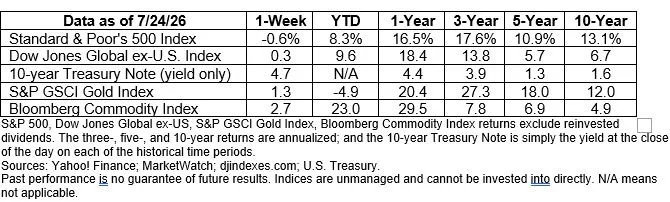
Last week, major U.S. stock indexes moved lower, and U.S. Treasuries moved higher. Randall Forsyth of Barron’s reported, “Real risk-free bond yields haven’t been this high in years. Real five-to-10-year yields hadn’t reached current levels since 2023-24. As for 30-year maturities, you would have to go back to the 2008-09 financial crisis to encounter real yields of nearly 3 percent. Real interest rates are what you earn after the bite taken by inflation.”
BABY BOOMERS HAVE ABOUT $93 TRILLION, BUT IT WON’T ALL GO TO THEIR HEIRS. In the United States, some in younger generations perceive baby boomers as the generation that caught every financial break. They believe boomers benefited from more affordable housing, lower tuition costs, and rising stock markets. When baby boomers look back, many recall facing significant economic headwinds during their working years, including double-digit mortgage rates, high inflation, and recessions.
Regardless of the circumstances, baby boomers have accumulated a lot of wealth. When compared to previous generations, baby boomers have more wealth than older generations did at the same age, according to Richard Fry of Pew Research.
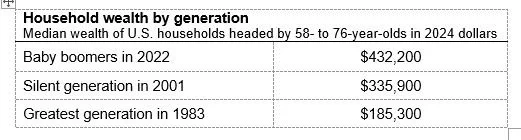
In total, boomers have about $93 trillion saved and invested, according to 2026 research from a digital payments firm. That’s about three times the U.S. gross domestic product, or GDP, which is the value of all goods and services our country produced last year. The amount that is passed on to heirs will be far less for several reasons:
1. $5 trillion in debt. Many baby boomers are still paying mortgages on their homes in retirement. Beyond housing, many also have credit card debt and auto, personal or business loans that will be repaid from their assets.
2. Wealth is not distributed evenly. Of the $88 trillion remaining after debts are paid, about 33 percent is held by the top one percent of households. When this group is left out of the calculations, the remaining baby boomers have about $60 trillion.
“…while excluding the top 1 percent makes the wealth estimate more realistic, it does not make the transfer democratic…most remaining wealth ($44 trillion) is still held by affluent boomers in the top 90 to 99 percent of households. In contrast, the bottom 90 percent of boomer households hold just $16 trillion,” according to the digital payments firm.
3. Retirement is expensive. A significant share of many households’ savings will be spent during retirement. In total, the researchers estimated that “$36 trillion will pass to younger generations over the next 20 years, equivalent to roughly $515,000 per inheriting household.”
Estate planning is important for many reasons. It ensures your assets are distributed as you want them to be. In addition, an estate plan can directly affect the amount heirs receive by minimizing taxes, avoiding probate, and reducing the likelihood of inheritance disputes. If you don’t have an estate plan or you haven’t reviewed your plan recently, get in touch. We can help.
WEEKLY FOCUS – THINK ABOUT IT
“We are cups, constantly and quietly being filled. The trick is, knowing how to tip ourselves over and let the beautiful stuff out.”
– Ray Bradbury, Author
Best regards,
Leif M. Hagen, CLU, ChFC
LPL Financial Advisor
Achievement Financial
Dream. Plan. Achieve.
P.S. Please feel free to forward this commentary to family, friends, or colleagues. If you would like us to add them to the list, please reply to this email with their email address and we will ask for their permission to be added.
Securities offered through LPL Financial, Member FINRA/SIPC.

* These views are those of Carson Coaching, not the presenting Representative, the Representative’s Broker/Dealer, or Registered Investment Advisor, and should not be construed as investment advice.
* This newsletter was prepared by Carson Coaching. Carson Coaching is not affiliated with the named firm or broker/dealer.
* Government bonds and Treasury Bills are guaranteed by the U.S. government as to the timely payment of principal and interest and, if held to maturity, offer a fixed rate of return and fixed principal value. However, the value of fund shares is not guaranteed and will fluctuate.
* Corporate bonds are considered higher risk than government bonds but normally offer a higher yield and are subject to market, interest rate and credit risk as well as additional risks based on the quality of issuer coupon rate, price, yield, maturity, and redemption features.
* The Standard & Poor's 500 (S&P 500) is an unmanaged group of securities considered to be representative of the stock market in general. You cannot invest directly in this index.
* All indexes referenced are unmanaged. The volatility of indexes could be materially different from that of a client’s portfolio. Unmanaged index returns do not reflect fees, expenses, or sales charges. Index performance is not indicative of the performance of any investment. You cannot invest directly in an index.
* The Dow Jones Global ex-U.S. Index covers approximately 95% of the market capitalization of the 45 developed and emerging countries included in the Index.
* The 10-year Treasury Note represents debt owed by the United States Treasury to the public. Since the U.S. Government is seen as a risk-free borrower, investors use the 10-year Treasury Note as a benchmark for the long-term bond market.
* Gold represents the 3:00 p.m. (London time) gold price as reported by the London Bullion Market Association and is expressed in U.S. Dollars per fine troy ounce. The source for gold data is Federal Reserve Bank of St. Louis (FRED), https://fred.stlouisfed.org/series/GOLDPMGBD228NLBM.
* The Bloomberg Commodity Index is designed to be a highly liquid and diversified benchmark for the commodity futures market. The Index is composed of futures contracts on 19 physical commodities and was launched on July 14, 1998.
* The DJ Equity All REIT Total Return Index measures the total return performance of the equity subcategory of the Real Estate Investment Trust (REIT) industry as calculated by Dow Jones.
* The Dow Jones Industrial Average (DJIA), commonly known as “The Dow,” is an index representing 30 stock of companies maintained and reviewed by the editors of The Wall Street Journal.
* The NASDAQ Composite is an unmanaged index of securities traded on the NASDAQ system.
* International investing involves special risks such as currency fluctuation and political instability and may not be suitable for all investors. These risks are often heightened for investments in emerging markets.
* Yahoo! Finance is the source for any reference to the performance of an index between two specific periods.
* The risk of loss in trading commodities and futures can be substantial. You should therefore carefully consider whether such trading is suitable for you in light of your financial condition. The high degree of leverage is often obtainable in commodity trading and can work against you as well as for you. The use of leverage can lead to large losses as well as gains.
* Opinions expressed are subject to change without notice and are not intended as investment advice or to predict future performance.
* Economic forecasts set forth may not develop as predicted and there can be no guarantee that strategies promoted will be successful.
* Past performance does not guarantee future results. Investing involves risk, including loss of principal.
* The foregoing information has been obtained from sources considered to be reliable, but we do not guarantee it is accurate or complete.
* There is no guarantee a diversified portfolio will enhance overall returns or outperform a non-diversified portfolio. Diversification does not protect against market risk.
* Asset allocation does not ensure a profit or protect against a loss.
* Consult your financial professional before making any investment decision.
* To unsubscribe from the “Peek of the Week” please reply to this email with “Unsubscribe” in the subject line or write us at Leif@AchievementFinancial.com
Sources:
https://en.wikipedia.org/wiki/Shock_absorber
https://www.atlasobscura.com/articles/how-america-joined-its-two-great-loves-cars-and-the-outdoors
https://www.investopedia.com/terms/s/systematicrisk.asp
https://www.investor.gov/introduction-investing/getting-started/asset-allocation
https://www.barrons.com/market-data?mod=BOL_TOPNAV or go to https://resources.carsongroup.com/hubfs/WMC-Source/2026/07-27-26-Barrons-DJIA-S&P-Nasdaq%20-%206.pdf
https://www.barrons.com/articles/rising-interest-rates-danger-markets-tips-215b867d? or go to https://resources.carsongroup.com/hubfs/WMC-Source/2026/07-27-26-Barrons-Rising-Interest-Rates-Are-A-Danger%20-%208.pdf