

The markets complete a 180 as U.S. infrastructure gets tested

Peek of the Week
Weekly Market Commentary
April 20,2026
The Markets
The market completes a 180.
One of the most exciting driving sequences in movies may be the scene from Baby Driver when “Baby” (a reluctant getaway driver) slings a red Subaru into a narrow 180-degree turn, slides backward between obstacles, and immediately pivots into another 180-degree turn, all while perfectly in sync with the beat of his music.
Since mid-February, the U.S. stock market has offered a similarly exciting ride.
The Standard & Poor’s 500 Index (S&P 500) was closing in on a record high level (7,000) in late February. Then the U.S. military conflict with Iran began and markets drifted lower. The S&P 500 hit bottom in late March when talk of a ceasefire inspired a 180 in outlook and U.S. stocks headed in the other direction. The index recovered lost value incredibly quickly. On Tax Day, it closed above 7,000 for the first time, reported Martin Baccardax of Barron’s.
There were three main drivers behind the remarkable recovery. These included:
Enthusiasm about the prospect of peace. Investor optimism surged on the possibility of an end to the Middle East conflict. “The stock market has now delivered a year’s return in about two weeks. While that might not be quite as impressive as all summer in a day, it’s been enough to provide a genuine reset for investors. The ‘end’ of the Iran war spurred a market celebration this week, even if the conflict is nowhere near officially over,” reported Teresa Rivas of Barron’s.
Over the 12 trading days of April through last Friday, the Nasdaq Composite Index had a double-digit gain, while the S&P 500 was up more than 8 percent, reported Rivas.
Excitement – again – about artificial intelligence (AI). Concerns about AI capacity being overbuilt and worries that data centers might not prove profitable, have faded amid rising demand, reported Joe Weisenthal and Tracy Alloway of Bloomberg.
“…AI can just do more as the models get better (not just cheaper), and obtain new capabilities, and this improvement should also be seen as a source of new demand. If, for example, [a new AI product] is as amazing at cybersecurity as all the hype says, then I’d expect we’ll see a big surge in AI consumption from people who work on securing computer networks.”
Investors’ appetite for AI is reflected in the performance of the S&P 500. Forty percent of its recent gains are owed to five of the biggest tech companies in the index, all are members of the Magnificent Seven, reported Baccardax.
A strong start to earnings season. Just 10 percent of the companies in the S&P 500 have reported on their performance during the first quarter. Among that group, more than 80 percent have reported positive revenue and earnings surprises. A positive surprise occurs when a company does better than analysts expected. In the first quarter of 2026, many of the companies that have reported took in more money and were more profitable than analysts anticipated, according to John Butters at FactSet.
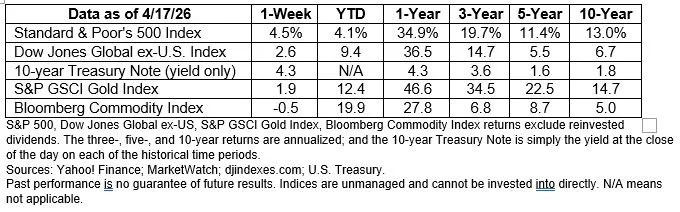
Last week, major U.S. stock indices finished the week higher. In addition, yields on most maturities of U.S. Treasuries moved lower over the week.
THE INFRASTRUCTURE TEST. Recently, heavy storms in the Midwest and elsewhere have severely tested aging U.S. infrastructure. There have been significant failures in flood defenses, power grids, and transportation networks, reported Anna Skinner of Newsweek.
Since 1998, the American Society of Civil Engineers (ASCE) has evaluated infrastructure in the United States every two years. The authors of the 2025 Report Card for America’s Infrastructure explained why the analysis is important:
“America’s infrastructure is the foundation on which our national economy, global competitiveness, and quality of life depend. While often taken for granted when it is working properly, every American household or business immediately feels the impact of just one inefficiency or failure in our built environment.”
Poorly maintained infrastructure is costly. The ASCE found that “potholes damaging our vehicles, traffic delays leading to lost productivity and increased costs for products, aging water lines leading to spiking water rates, etc. – costs each American household $2,700 per year.”
How well is the United States maintaining its infrastructure?
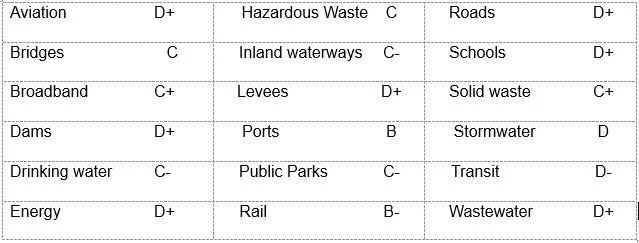
The most recent Report Card for America’s Infrastructure graded 18 categories of infrastructure, and the grades weren’t good. The lowest marks were for systems that affect millions of Americans: a D- for transit and a D for stormwater.
Overall, U.S. infrastructure earned a ‘C’, meaning mediocre condition; requires attention. Here’s how America’s infrastructure fared:
For investors, deteriorating infrastructure can weigh on local economies, raise business operating costs, and (when spending accelerates) create opportunities for growth in industries that benefit.
WEEKLY FOCUS – THINK ABOUT IT
“Always do what is right. It will gratify half of mankind and astound the other.”
― Mark Twain, Author
Best regards,
Leif M Hagen, CLU, ChFC
LPL Financial Advisor
Achievement Financial
Dream. Plan. Achieve.
P.S. Please feel free to forward this commentary to family, friends, or colleagues. If you would like us to add them to the list, please reply to this email with their email address and we will ask for their permission to be added.
Securities offered through LPL Financial, Member FINRA/SIPC.

* These views are those of Carson Coaching, not the presenting Representative, the Representative’s Broker/Dealer, or Registered Investment Advisor, and should not be construed as investment advice.
* This newsletter was prepared by Carson Coaching. Carson Coaching is not affiliated with the named firm or broker/dealer.
* Government bonds and Treasury Bills are guaranteed by the U.S. government as to the timely payment of principal and interest and, if held to maturity, offer a fixed rate of return and fixed principal value. However, the value of fund shares is not guaranteed and will fluctuate.
* Corporate bonds are considered higher risk than government bonds but normally offer a higher yield and are subject to market, interest rate and credit risk as well as additional risks based on the quality of issuer coupon rate, price, yield, maturity, and redemption features.
* The Standard & Poor's 500 (S&P 500) is an unmanaged group of securities considered to be representative of the stock market in general. You cannot invest directly in this index.
* All indexes referenced are unmanaged. The volatility of indexes could be materially different from that of a client’s portfolio. Unmanaged index returns do not reflect fees, expenses, or sales charges. Index performance is not indicative of the performance of any investment. You cannot invest directly in an index.
* The Dow Jones Global ex-U.S. Index covers approximately 95% of the market capitalization of the 45 developed and emerging countries included in the Index.
* The 10-year Treasury Note represents debt owed by the United States Treasury to the public. Since the U.S. Government is seen as a risk-free borrower, investors use the 10-year Treasury Note as a benchmark for the long-term bond market.
* Gold represents the 3:00 p.m. (London time) gold price as reported by the London Bullion Market Association and is expressed in U.S. Dollars per fine troy ounce. The source for gold data is Federal Reserve Bank of St. Louis (FRED), https://fred.stlouisfed.org/series/GOLDPMGBD228NLBM.
* The Bloomberg Commodity Index is designed to be a highly liquid and diversified benchmark for the commodity futures market. The Index is composed of futures contracts on 19 physical commodities and was launched on July 14, 1998.
* The DJ Equity All REIT Total Return Index measures the total return performance of the equity subcategory of the Real Estate Investment Trust (REIT) industry as calculated by Dow Jones.
* The Dow Jones Industrial Average (DJIA), commonly known as “The Dow,” is an index representing 30 stock of companies maintained and reviewed by the editors of The Wall Street Journal.
* The NASDAQ Composite is an unmanaged index of securities traded on the NASDAQ system.
* International investing involves special risks such as currency fluctuation and political instability and may not be suitable for all investors. These risks are often heightened for investments in emerging markets.
* Yahoo! Finance is the source for any reference to the performance of an index between two specific periods.
* The risk of loss in trading commodities and futures can be substantial. You should therefore carefully consider whether such trading is suitable for you in light of your financial condition. The high degree of leverage is often obtainable in commodity trading and can work against you as well as for you. The use of leverage can lead to large losses as well as gains.
* Opinions expressed are subject to change without notice and are not intended as investment advice or to predict future performance.
* Economic forecasts set forth may not develop as predicted and there can be no guarantee that strategies promoted will be successful.
* Past performance does not guarantee future results. Investing involves risk, including loss of principal.
* The foregoing information has been obtained from sources considered to be reliable, but we do not guarantee it is accurate or complete.
* There is no guarantee a diversified portfolio will enhance overall returns or outperform a non-diversified portfolio. Diversification does not protect against market risk.
* Asset allocation does not ensure a profit or protect against a loss.
* Consult your financial professional before making any investment decision.
* To unsubscribe from the “Peek of the Week” please reply to this email with “Unsubscribe” in the subject line or write us at Achievement Financial; Leif@AchievementFinancial.com
Sources:
https://www.barrons.com/articles/stocks-war-oil-record-f69d42a1?mod=hp_LEDE_C_1_B_1 or go to https://resources.carsongroup.com/hubfs/WMC-Source/2026/04-20-26-Barrons-The-S&P-Just-Surged%20-%202.pdf
https://finance.yahoo.com/quote/%5EGSPC/history/
https://www.barrons.com/articles/peace-earnings-ai-stocks-new-records-74056d11?mod=hp_LEDE_B_1_B_1 or go to https://resources.carsongroup.com/hubfs/WMC-Source/2026/04-20-26-Barrons-Peace-Earnings-and-AI%20-%204.pdf
https://www.bloomberg.com/news/newsletters/2026-04-13/you-don-t-hear-much-about-the-ai-overbuild-anymore or go to https://resources.carsongroup.com/hubfs/WMC-Source/2026/04-20-26-Bloomberg-You-Dont-Hear-Much-About%20-%205.pdf
https://www.barrons.com/market-data?mod=BOL_TOPNAV or go to https://resources.carsongroup.com/hubfs/WMC-Source/2026/04-20-26-Barrons-DJIA-S&P-Nasdaq%20-%207.pdf
https://infrastructurereportcard.org/2025-infrastructure-report-card-one-year-later/
https://www.goodreads.com/quotes/923-always-do-what-is-right-it-will-gratify-half-of